

You know what you want to say. You've done the work. But halfway through explaining it in English, you lose a word, restart the sentence and forget where you were going.
Prepare for that moment as well as the question itself. Practice a short example from your experience, a way to clarify the question, and a sentence you can use to restart.
The British Council recommends practicing interview answers aloud and reviewing vocabulary relevant to your field. You can build that practice around the situations that give you the most trouble. British Council
Start with an answer you can say comfortably
Pick a question such as "Tell me about a time you solved a problem."
Write three notes: the problem, what you did, and the result. Then explain them using words you already use.
For example, someone describing a scheduling problem could say:
"We had two people booked for the same appointment. I checked the calendar, contacted both customers and arranged a new time for one of them. After that, I added a confirmation step so we could catch the same problem earlier."
The actions carry the answer. Check the vocabulary that matters for your role, especially technical terms, but keep the rest of the sentence easy to say.
If you keep stumbling over a phrase, rewrite it. "I was responsible for the implementation of a new process" could become "I introduced a new process." Choose the wording that accurately describes your work.
Three ways to find your next sentence
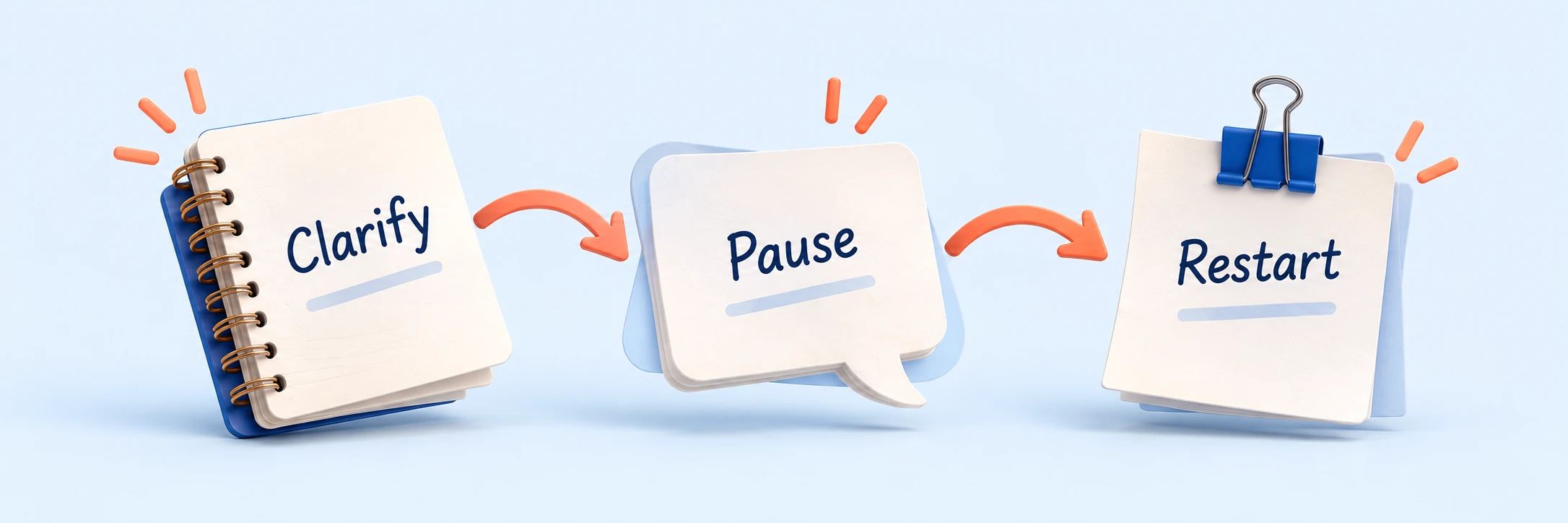
Practice these three recovery moments
1. You did not catch the question
Try:
"Could you repeat the last part of the question, please?"
Or check the meaning:
"Are you asking how I handled the disagreement, or what the team did afterward?"
Practice asking, listening to the response and then answering. That whole exchange is part of the exercise.
2. You understand, but need a moment
Try:
"Let me think of a specific example."
Use the pause to choose the story and its first sentence. Start with something concrete: "In my previous role, we had..." or "During a group project, I..."
3. Your sentence gets tangled
Try:
"Let me explain that more clearly."
Then return to the action: "What I did was..."
For the scheduling example, the restart might be: "What I did was check the calendar and call the customers." You have a clear place to continue from.
Choose one phrase for each situation and say it aloud several times. Use a phrase that feels comfortable in your own voice.
Add the follow-up you haven't rehearsed
Once your main answer feels familiar, change the question.
Ask a friend to choose one follow-up:
- "Why did you choose that approach?"
- "What was the hardest part?"
- "What would you do differently now?"
Answer using the same experience. Keep a few notes nearby, but give yourself room to find the wording as you speak. If you get stuck, use one of your recovery phrases and continue.
For the appointment example, "Why did you choose that approach?" could lead to:
"I wanted to confirm the details before offering a solution. Once I knew what had happened, I could explain the options to each customer."
Now you have practiced both the story and the reason behind your decision.
Check one thing on the next attempt
Listen back to a practice answer or ask someone for feedback. Pick one question to focus on:
- Was the main point easy to follow?
- Did I leave out what I personally did?
- Which sentence was difficult to finish?
Change that part and answer again. Keep useful technical language; simplify a sentence that keeps getting in your way.
Interview Coach offers questions shaped by the role and job context you provide, with feedback on your practice answers. Use the next session to explain one real example and work on the part that feels hardest to say.
Start practicing free. Begin with the job you're interviewing for and one experience you want to talk through.